 中文
中文 Português
 Русский
 Español
 English
Haihao Group Ships MSS SP-97 Branch Fittings to UAE
For a piping project, branch connections are often small compared with the main line, but their specifications cannot be treated as a minor detail. The flange class, branch size, material, wall thickness and facing all have to match the piping system.
Haihao Group recently completed an order of MSS SP-97 branch fittings for a customer in the UAE. The order covers main sizes from 4″ to 42″, with a consistent 1.5″ branch size, and includes Class 150, Class 300 and Class 600 configurations. RF and RTJ facings are both included, together with several forged materials selected for different service requirements.
One Order, Multiple Piping Requirements
One of the notable features of this UAE order is the range of combinations rather than a single standard configuration.
The smaller end of the order includes a 4″ × 1.5″ fitting in ASTM A350 LF2 Class 1, Class 600, with an RTJ flange and 150 mm overall length. At the other end, the order includes 42″ × 1.5″ components in ASTM A350 LF2 Class 1, Class 300, RF configuration.
Between these two sizes are 6″, 8″, 10″, 12″, 14″, 16″, 18″, 20″, 24″, 30″ and 36″ main-line sizes. This range requires careful control of dimensional relationships, wall thickness and flange configuration during production.
For procurement teams, this is also where MSS SP-97 branch fittings become more than a simple catalogue item. The fitting has to correspond with the actual pipe schedule and the flange connection specified for the project.
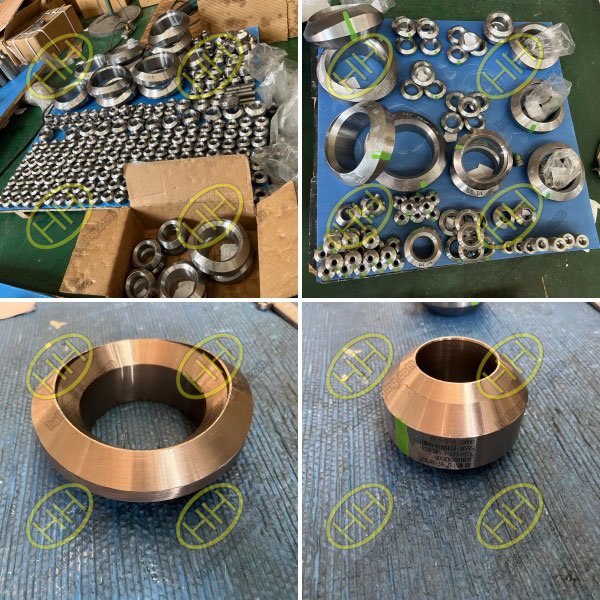
MSS SP-97 branch fittings in A105 and A350 LF2
Material Selection Follows the Service Requirement
The order uses four major material groups.
ASTM A105 is used for several carbon steel configurations, including Class 150 and Class 300 RF designs. These fittings are paired with different main-pipe wall thicknesses, such as SCH 20, SCH 40 and SCH 60, depending on the size and piping design.
ASTM A350 LF2 Class 1 accounts for a substantial portion of the order, particularly the Class 600 RTJ configurations. This material is commonly selected where low-temperature toughness is an important consideration. Several items in the order are also identified for sour-service applications, so the material and manufacturing requirements need to be controlled accordingly.
For corrosion-resistant service, the customer specified ASTM A182 F316/F316L dual-grade stainless steel. These fittings appear in both Class 300 RF and Class 600 RTJ configurations, with main-line sizes extending from 6″ through 36″.
The order also includes ASTM A182 F11 Class 2 in Class 600 RTJ configurations. This provides another material option for piping systems where alloy steel is required.
This material diversity is one reason why MSS SP-97 branch fittings should be purchased according to the complete specification rather than by size alone.
RF and RTJ Flanges for Different Connections
The UAE order contains both raised-face and ring-type-joint configurations.
Class 150 and Class 300 items are mainly supplied with RF flanges, while a number of Class 600 items use RTJ flanges. The flange requirements are based on ASME B16.5, while the branch fitting dimensions and construction follow MSS SP-97.
The difference is important during project procurement. A fitting with the correct nominal size but the wrong flange facing or pressure class may not match the mating flange in the piping system.
For example, the order includes:
10″ × 1.5″ ASTM A182 F316/F316L, Class 600, RTJ
14″ × 1.5″ ASTM A350 LF2 Class 1, Class 600, RTJ
20″ × 1.5″ ASTM A182 F316/F316L, Class 600, RTJ
24″ × 1.5″ ASTM A350 LF2 Class 1, Class 600, RTJ
30″ × 1.5″ ASTM A182 F316/F316L, Class 300, RF
36″ × 1.5″ ASTM A182 F316/F316L, Class 300, RF
42″ × 1.5″ ASTM A350 LF2 Class 1, Class 300, RF
The combination of size, schedule, material and facing was checked against the individual purchase requirements rather than applying one configuration across the entire batch.
Dimensional Control from 4″ to 42″
Large-diameter branch connections require particular attention to dimensional consistency. In this order, main pipe sizes range from 4″ to 42″, while branch size remains 1.5″. Wall thickness combinations include SCH 20, SCH 30, SCH 40, SCH 60, SCH 80, SCH 160 and XS, as well as specified wall thicknesses in millimetres.
The fitting lengths are also not identical. The order contains 150 mm, 200 mm and 250 mm lengths depending on the individual specification.
For MSS SP-97 branch fittings, these details directly affect installation and fit-up. Matching the branch size alone is not enough; the fitting must correspond to the pipe wall thickness, flange rating and project connection requirements.
Haihao Group’s Approach to Custom Piping Orders
For international piping orders, the challenge is often the combination of specifications rather than the manufacturing of one individual fitting.
This UAE project required multiple materials, pressure classes, flange facings, wall thicknesses and lengths within the same order. Haihao Group handled the specifications item by item, covering carbon steel, low-temperature alloy steel, stainless steel and Cr-Mo alloy steel configurations.
That approach is particularly useful for EPC contractors, distributors and project procurement teams who need MSS SP-97 branch fittings supplied to a detailed material and dimensional specification instead of a standard stock configuration.
If your project requires branch connection fittings in A105, A350 LF2, A182 F316/F316L or A182 F11, send us the main size, branch size, schedule, material, flange class, facing and required standard. Haihao Group can review the specification and provide a suitable quotation for your piping project.